- See the exact zoning boundaries on the Local Area Plan map
- P2 (Jigginstown) is 54.55 hectares - about 7x the area of Croke Park, and larger than P1
- P1 could draw up to 180MW at full buildout; data centres already use 23% of Ireland's electricity
- 6 sets of on-site gas turbines and engines applied for on P1 - one per building
- Reporting data centres used 999 million litres of water in 2025 alone, up 33% on 2024
- 225 jobs once P1 is fully built out, across all six buildings
- Ireland hosts about 25% of Europe's entire data centre market
The zoning, on the map
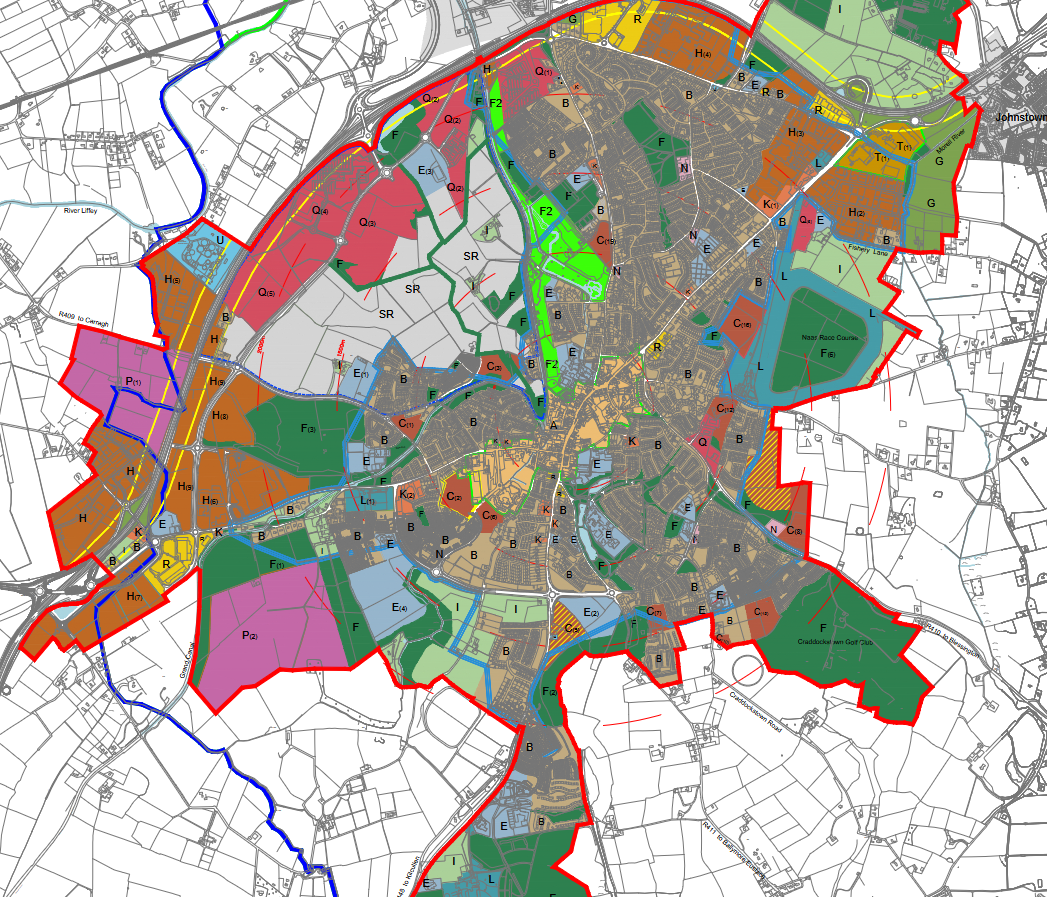
Naas Local Area Plan 2021-2027 land use zoning map. The two magenta "P" parcels on the west side are the data centre zonings.
Scale
Croke Park's core stadium footprint is approximately 7.66 hectares (18.9 acres). Neither crokepark.ie nor the GAA publish an official site-area figure, so we measured it ourselves from the stadium boundary mapped on OpenStreetMap, then excluded a car park included within that mapped boundary (about 0.28 hectares, southwest of the pitch, near St. Patrick's Terrace) so the comparison is stadium-to-site rather than stadium-plus-car-park-to-site.
Electricity & grid
The Commission for Regulation of Utilities has tightened its policy on new data centre grid connections, citing security-of-supply concerns, and EirGrid has repeatedly flagged capacity constraints on the national network - this is part of the "material change in circumstances since 2021" argument behind our rezoning case (see P2 & The Ask), though we have not yet linked it to a specific CRU or EirGrid publication; we'll add a direct citation here once we have one.
Gas & emissions
Source: KCC Planner's Report (20 Aug 2025), Condition 4-6, p.83-85.
Water
Source: The Irish Times, "Nationwide hosepipe ban: what is allowed? Who is exempt?", 24 Jul 2026.
The clearest year-on-year figures yet
A July 2026 investigation by The Journal, based on figures the largest data centres are required to report to the EPA, put a firmer number on this: reporting data centres used 752 million litres of public water in 2024 and 999 million litres in 2025 - a 33% year-on-year increase, and just over 1.7 billion litres combined, in line with the figures cited above. Just two campuses accounted for the overwhelming majority of 2025's total: Meta's Clonee, Co. Meath campus (556 million litres) and Equinix's Dublin campus (398 million litres) between them used 954 million litres - over 95% of the national figure - while Amazon, Google and Microsoft's Irish campuses combined used the remaining 44 million litres.
For scale, pharmaceutical manufacturing uses far more water annually: six pharma plants reporting to the EPA used over 4 billion litres between them over the same two years - more than double all data centres combined - led by Pfizer's Grange Castle plant (1.2 billion litres). Raising the fairness question directly, Labour TD Ciarán Ahern, who obtained separate water-use figures from Uisce Éireann, said: "large industry isn't being asked to do anything, and no pressure at all appears, at least publicly, to be put on these industries to manage or curtail... their water usage," while the hosepipe ban restricts ordinary households.
Source: The Journal Investigates, "Data centres used almost one billion litres of water last year, but another industry used far more," 24 Jul 2026 (Conor O'Carroll & David Mac Redmond).
Why the exemption matters most on the days it's least noticed
This is the part that doesn't show up in an annual average: air-cooling-only systems fall back to water specifically when it's hot, and hot, dry spells are exactly when water bodies and reservoirs are already lowest. As An Taisce's head of advocacy put it: "just as that's when households need the water, it's also exactly when these water bodies start to run low" - and when levels drop, pollution already in the water becomes more concentrated. A 2024 review for the Water Forum (an official statutory water-policy body) makes the same point independently: "peak water demand often coincides with prolonged periods of warm, dry weather, when low flows and decreased water levels in rivers and lakes result in reduced water availability for public water supplies," and specifically warns that in the Greater Dublin Area, "these drought periods will coincide with the need for peak water usage at data centres."
Sources: Dublin Inquirer, 26 Jun 2026 (Elaine McGoff, An Taisce, quoted directly); McGrath & Alamamos, "Water use by data centres: An Irish Context," the Water Forum, updated Oct 2024, p.2 & p.4.
A back-of-envelope estimate: what if this water use is concentrated into just 1-2 months?
This is illustrative arithmetic, not a verified measurement - nobody we've found publishes day-by-day water-use data for an Irish data centre, although it's curious in itself why accurate, granular data on data centres isn't publicly available given the scale of what they use. But operators themselves say cooling switches from air to water somewhere in the 25-29.4°C range, which in Ireland's climate plausibly happens for at most one to two months a year (likely less - we're deliberately using a generous, conservative assumption). If we take the 999 million litres reported for 2025 and assume, purely for illustration, that most of it fell within that short window rather than spreading evenly across the year:
- Spread evenly across 365 days, that's about 2.7 million litres/day - roughly the "quiet annual average" that framings like Uisce Éireann's "0.3% of daily supply" are built on.
- Concentrated into 2 months (61 days) instead, that's closer to 16 million litres/day.
- Concentrated into 1 month (30 days), it's closer to 33 million litres/day - roughly 12 times the "annual average" figure.
This is also why comparing data centres' annual total to pharmaceutical plants' annual total is a bit of an apples-to-oranges exercise: pharma manufacturing runs at a fairly steady rate all year round, while data centre cooling water use is plausibly weighted heavily toward exactly the hot, dry weeks when supply is already under the most strain - the scenario a national or annual average is least able to capture.
The official "data centres barely use any water" figure doesn't add up
Uisce Éireann's standard line, repeated to TDs and journalists for years, is that data centres use about 0.13-0.2% of national water supply. But in 2021 - the same year that figure is based on - Meta alone reported withdrawing 928 megalitres of water for its Clonee, Co. Meath data centres. Uisce Éireann's entire national total for all data centres that year was 810 megalitres. One company's own reported figure was larger than the regulator's total for the whole country. Asked to explain the gap, an Uisce Éireann spokesperson said in June 2026 that it "couldn't lay out its methodology" behind the 810-megalitre figure, and couldn't provide more up-to-date numbers "since the AI boom." The Water Forum review separately notes that a national percentage is misleading anyway, since 87-93% of Ireland's data centres are concentrated in Dublin and the Greater Dublin Area - the true comparison that matters is against regional, not national, water demand.
Source: Dublin Inquirer, "Does Irish Water even know how much water data centres are using?", 26 Jun 2026 (Meta/Uisce Éireann figures, methodology admission); Water Forum review, p.3 (regional concentration point).
Nobody can currently verify how much groundwater data centres use
Uisce Éireann's figures only cover data centres connected to the public mains - as of 2021 that was 24 out of roughly 70-82 operating at the time. Where the rest source their water isn't tracked centrally: Uisce Éireann says it "has no information in relation to the use of private water sources such as boreholes as that is outside the utility's remit," and the EPA - which is supposed to register anyone abstracting over 25,000 litres a day - confirmed in June 2026 that "there are no data centres registered for groundwater abstraction or otherwise." Separately, under the EU Energy Efficiency Directive, large data centres are now required to report annual water use to the European Commission - but in the first reporting round, only 18 of an estimated 123 Irish data centres (15%) actually submitted figures.
Source: Dublin Inquirer, 26 Jun 2026.
Where does the wastewater actually go?
Everything above is about water going in. Less attention goes to what comes back out. Cooling-tower "blowdown" - water drained off periodically to stop dissolved minerals building up - carries concentrated dissolved solids plus whatever corrosion inhibitors, scale inhibitors and biocides were dosed into the system to keep it running clean, and is typically discharged warmer than it arrived. This is generic engineering fact about how cooling towers work anywhere, not an Irish-specific measurement - we haven't found a published breakdown of what Irish data centre cooling wastewater actually contains once it leaves the site, in the way we can point to figures for water taken in. Discharging to the public sewer requires a trade effluent authorisation from Uisce Éireann or the EPA, the same regime that applies to any large industrial user.
For the Dublin area - where 87-93% of Ireland's data centres are concentrated (see above) - that discharge overwhelmingly ends up at Ringsend, Ireland's largest wastewater plant, which treats around 40% of the country's public wastewater. Ringsend just finished a €550 million upgrade (completed February 2026) taking its capacity to 2.4 million population equivalent - and its own chief executive says it's already within sight of full again: "there's nowhere to go outside of this area," Uisce Éireann's Niall Gleeson said, putting the plant's remaining headroom at roughly 100,000 more people before Dublin needs its next wastewater plant (the planned Greater Dublin Drainage project at Clonshaugh) to take any further growth.
We haven't found a published figure attributing a specific share of that load to data centres, so we're not claiming one - unlike the water-use figures above, nobody seems to publish a data-centre-specific breakdown for wastewater either. What we can say is that data centres are large, water-intensive commercial users concentrated in exactly the catchment area under the most pressure, discharging under the same licensing regime as anyone else, into a plant whose own operator says has very little room left.
Sources: U.S. Department of Energy, "Best Management Practice #10: Cooling Tower Management" (general cooling tower blowdown composition, not Ireland-specific); RTE, 26 Feb 2026 (Ringsend upgrade completion and capacity); Water Forum review, p.3 (Dublin/GDA data centre concentration).
As a real-world data point within the 0.5-5 million litres/day range: Meta's Clonee, Co. Meath data centres withdrew 928 megalitres of water in 2021 (about 2.5 million litres/day averaged over the year), falling to 659 megalitres in 2023. Google's Dublin data centre, which uses air cooling, reported withdrawing only 2.7 million litres for the whole of 2023 - a reminder that water use varies hugely by cooling technology and operator, not just by facility size. We haven't yet located a specific, publicly stated water-demand figure for the Herbata (P1) application itself; the planner's report and conditions address surface-water and wastewater management but we have not extracted a headline potable/process water demand number from the file.
Source: Water Forum review, p.5, citing Meta's and Google's own published sustainability reports.
Jobs
Construction-phase employment is separate and temporary: the Planner's Report cites c.1,100 construction workers at peak (Chapter 12/EIAR, p.73 of the Planner's Report).
National context
Naas isn't unique - these pressures show up in national figures too. The stats below are from Friends of the Earth Ireland's May 2025 data centre briefing (original, friendsoftheearth.ie · local copy), which in turn cites the bodies named; we haven't independently re-derived each figure, so treat these as "FOE reports that..." rather than our own primary research.
Source: UN University Institute for Water, Environment and Health, "Environmental Cost of AI's Energy Use: Carbon, Water and Land Footprints," cited in The Irish Times, 3 Jun 2026.
A note on how we handle numbers
Every figure above is attributed to a specific document and, where possible, a page. Where a claim comes from campaign correspondence rather than an official document, we say so and haven't smoothed over the difference. Where we haven't yet been able to locate a primary source for something we've heard, we've said that too rather than dropping the caveat. If you find a figure on this page that looks wrong, outdated, or needs a better citation, please tell us.